
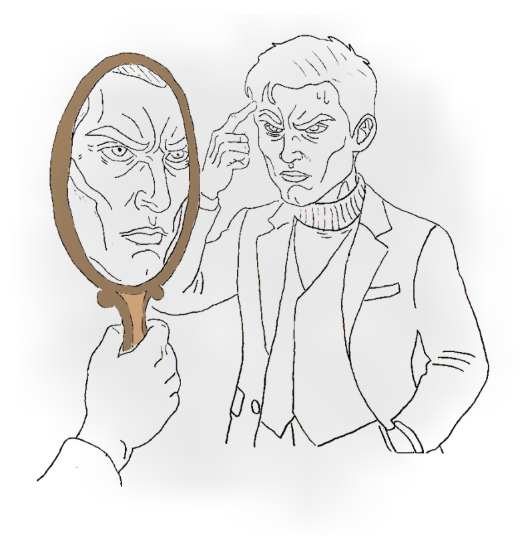




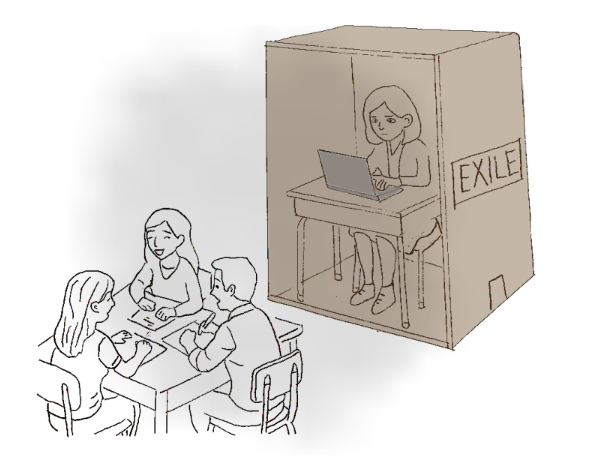


As the school year comes to an end, students in health teacher Lael McAuliffe’s health classes are finishing a new critical thinking pilot built around a skill that feels increasingly urgent in the age of AI: learning how to think before accepting an answer, while also testing a different kind of school tool. It is not an app designed to give faster answers. It is an app designed to make students pause before reaching one.
The pilot curriculum, connected to UC Berkeley’s “Sense and Sensibility and Science” course, created by Nobel Prize-winning Saul Perlmutter is organized into a sequence of modules that teach students how to evaluate evidence, recognize bias, question assumptions and make decisions under uncertainty.
“This class is incredibly important, especially as students move into a world shaped more and more by AI,” health teacher Lael McAuliffe said. “Students are going to have access to more information than ever before, but access to information is not the same as understanding it. They need to know how to question what they see, evaluate evidence, recognize bias and make thoughtful decisions.”
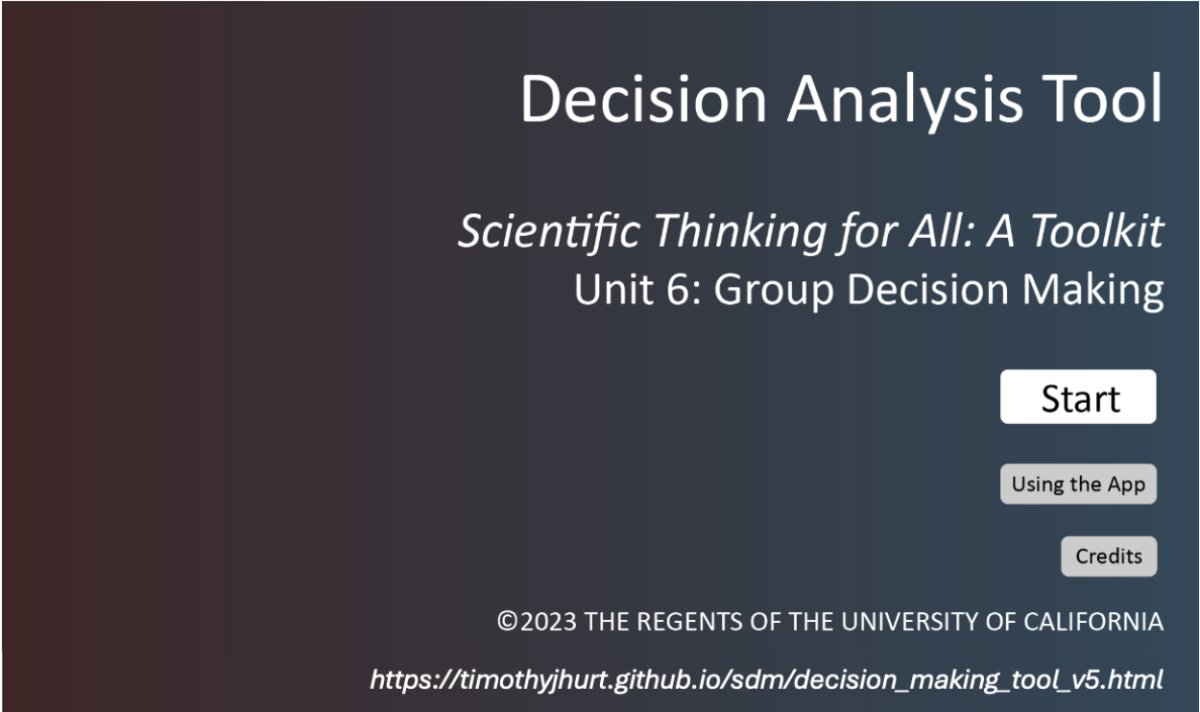
One part of the pilot is a decision-making app, which gives students a practical way to use those skills in real life. The app guides students through questions such as: What evidence do I have? What assumptions am I making? What alternatives should I consider? What could happen next?
Students interested in trying the decision-making tool can access the app here:
https://timothyjhurt.github.io/sdm/decision_making_tool_v5.html
The app is only one part of the larger class. In the classroom, students also engage in discussion, analyze real-world situations and practice applying scientific reasoning to everyday choices. The goal is to give students a structure for thinking more critically, slow down, question what they read and consider all possible explanations. In a world where AI tools can generate responses instantly, the app asks students to do something slower and harder: think through the decision themselves.
“Before this class, I would usually just decide what I thought about something pretty quickly,” sophomore Chase Hench said. “Now I catch myself asking what evidence I actually have, what assumptions I’m making and whether there is another explanation. I use that outside of school too.”
Superintendent Jennifer Hawn said the pilot fits into a broader need to prepare students for a future in which information is easier to access, but harder to judge.
“I wanted to help support this initiative because I could see how much these modules engaged students to think critically about the world,” Hawn said. “The kind of thinking that the course teaches is not just something to be applied inside the classroom, it’s a life skill.”
The pilot also comes at a moment when PHS is thinking about what kinds of classes best prepare students for the future. Next year, the school is adding several AP courses, giving students more opportunities to take advanced academic classes. But some students are questioning whether more AP classes alone are enough.
“As a senior, I’m glad students have more AP options, but I also wonder if we needed more classes that teach us how to think, not just how to prepare for another test,” senior Andrew King said. “With AI changing so much, decision-making and critical thinking are skills every student should have before graduating.”
That question does not end after high school. For some former students, the difference between taking advanced classes and learning how to think independently becomes clear in college.
“When I got to college, I realized that AP classes helped me handle a heavy workload, but they did not always prepare me for open-ended thinking,” former PHS student Daniel Banin said. “The hardest part at first was learning how to question ideas, form my own conclusions and think critically when there was no obvious right answer.”
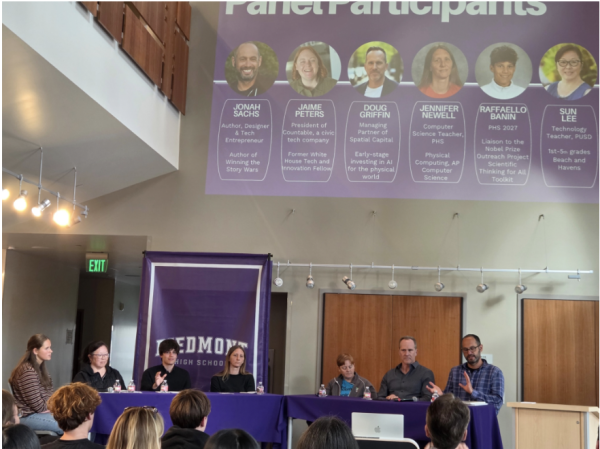
The need for these skills was also part of Friday’s PHS panel, “Beyond the Chatbot: Exploring the AI Horizon,” where students, educators and industry voices discussed how artificial intelligence is changing school and work. Moderated by PUSD Director of Instructional Technology, Stephanie Griffin, and PHS senior and TPH design editor, Mira Sachs, the panel brought together voices from across education, technology and entrepreneurship.
Panelists included PHS computer science teacher, Jennifer Newell; Havens Elementary School educator, Sun Lee; PHS junior and digital editor of TPH, Raffaello Banin; education strategist and president of Countable, Jamie Peters; venture capitalist at Spatial Capital, Doug Griffin; and tech entrepreneur and author of Winning the Story Wars, Jonah Sachs.
Topics like chatbot tutors, vibe coding, and new forms of digital creation were discussed, but the center of the discussion, and the biggest questions from the parents and students in the audience were not just how students should use AI. It was what students still needed to learn for themselves.
Lee said that even elementary school students are already using tools like ChatGPT, sharing that one of her students had used it to write a poem for her. The example sparked a larger question from the audience. “Is this really creation?” one audience member asked.
Panelists also discussed whether schools should ban AI tools or teach students how to use them responsibly. When one audience member asked where schools should allow AI, Newell said students still need to go through the struggle of learning first. “That struggle is what makes them grow,” Newell said. “Only after students understand the process,” she added, “can AI be useful for more standard or routine tasks.”
That is where the decision-making app connects to the larger AI conversation. It does not treat technology as the answer to every problem. Instead, it uses technology to help students practice a human skill: judgment.
As AI speeds up the world around them, PHS students are being asked to slow down. The pilot may be ending, but the question it raises is just beginning: in an age of instant answers, how can schools teach students to make better decisions?