


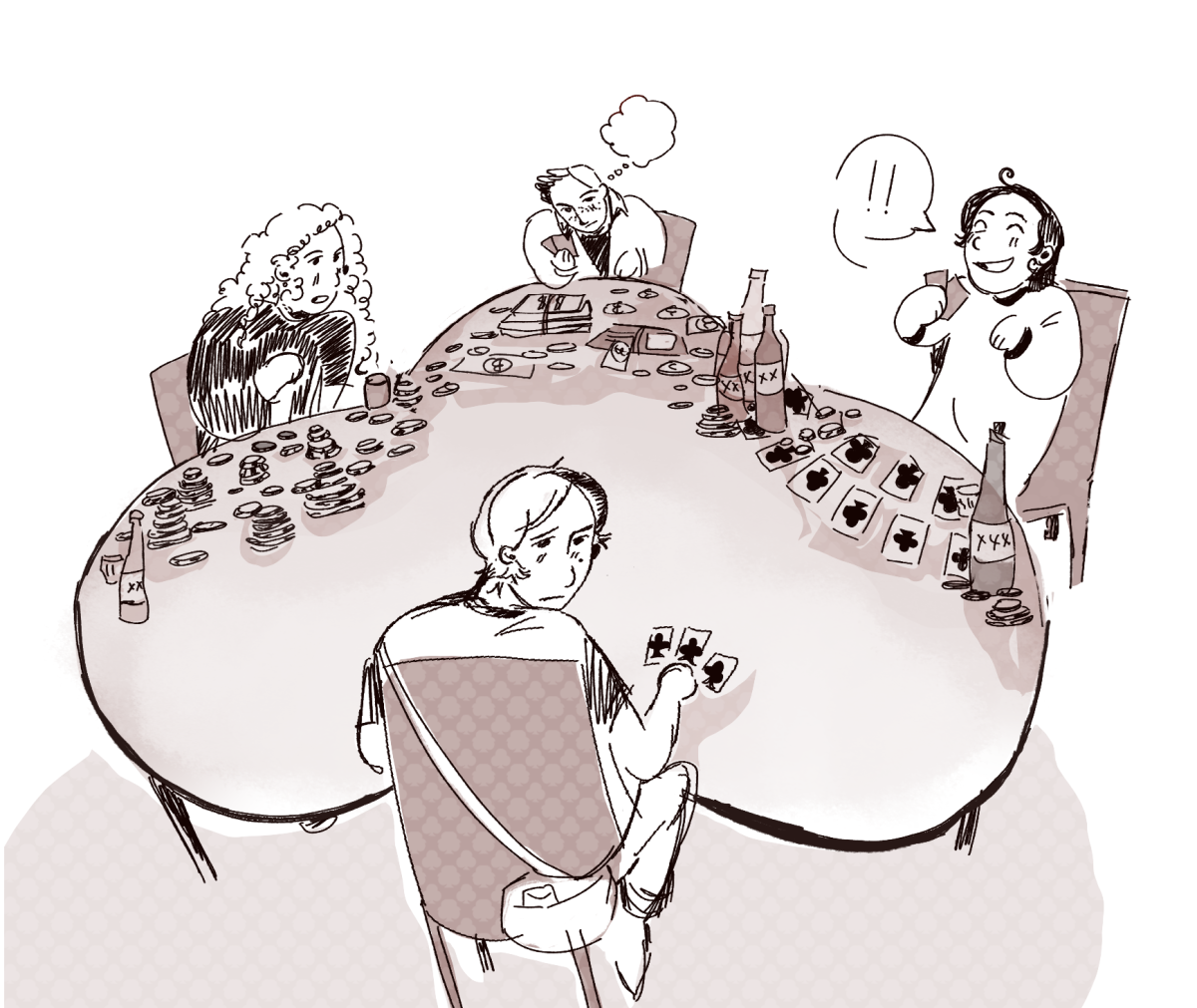













Sitting around the table, a group six of boys peek at their cards. Three of them immediately fold and sulk over their lost buy-ins. The dealer flips over the cards, revealing the flop. Faces of excitement and tragedy surround the table. One player checks. Another raises. The remaining player looks at his cards, takes a deep breath, and shoves forward 15 dollars. The others match his bet and clench their hands in fear and excitement before the turn to reveal if they will win significantly or face a devastating loss.
Senior Jason Shum said that he and his friend group often play poker for money with each other on weekends.
“A lot of my friends and I decided that it would be a lot more fun if we just played with money, and then one of us got a [poker] table,” Shum said.
Shum said that the buy-in for these games is 20 dollars, and that five to eight people typically play, keeping their chips every time and occasionally cashing out.
“We play with the same group of people, so we usually just keep our chips,” Shum said. “If you want to buy in, it would be 20 bucks at the beginning.”
Shum said that the pots of money, or how much is being gambled in total in one hand, is usually pretty low stakes. However, sometimes the intensity can rise.
“Our big blinds and small blinds are like 10 and 20 cents. The pots can usually get up to like five bucks, but the biggest has been like 10 bucks,” Shum said. “I know people who play with much higher stakes, like five and 10 buck buy-ins which lead to huge pots.”
Shum said he does not worry about losing money because he plays with a skill that wins him back whatever he loses, making him even on his profit to losses ratio.
“I’ve never had to buy back in,” Shum said. “Others haven’t been so lucky.”
Shum said that gambling through poker is a mix of skill and luck, not just one or the other.
“There’s definitely skill, like reading your opponent or knowing the patterns your opponent plays by,” Shum said. “But there’s definitely luck involved, like you could get something crazy on the river.”
Anonymous junior Victor said that alcohol is always present when he and his friends play poker.
“I feel like I play worse when I do consume [alcohol],” Victor said. “There’s always beer [present] at least.”
Shum said that the atmosphere of the poker table shifts throughout the evening.
“Usually throughout most of the night, it’s a friendly competition,” Shum said. “As the pot gets bigger and bigger, it gets more intense and then it really gets serious. I’ve seen some of my friends [get super angry] and threaten to flip the table when they lose big hands, or actually act on flipping the table.”
Another method of gambling is “coin flips”, where two individuals bet on the outcome of flipping a coin. Senior Ryan Graham said coin flipping is one that has risen in popularity among high school students.
“[I do it] for the dopamine,” Graham said. “It’s just amazing. You have to try it.”
Graham said he coin flips a few times a week, and that he usually only bets five to 10 dollars in these coin flips.
“I do it at school, cause you gotta do it with other people,” Graham said. “It’s like five, 10 bucks, you don’t need to bet a lot of money. A little dopamine rush never hurts the soul.”
Graham said that while he does these coin flips so frequently, he hasn’t really lost any money.
“I would say I’m completely even, like very close to [completely even],” Graham said. “Maybe [I’m down] like a tiny bit, but not much because it’s with other people. It’s a complete 50-50 shot. The whole idea is you’re gonna be even if you do it enough.”
Another form of gambling is online competitions between friends or strangers through Fantasy Football buy-ins or March Madness brackets. Anonymous senior Bruce said in Fantasy Football, he and his friends all put in a pool of money for the winner, and that the loser has to do a punishment.
“I guess it is kind of a gamble doing Fantasy Football. At the end of the day though no one really cares about the money, it’s just about avoiding the punishment,” Bruce said.
These Fantasy Football punishments range from the loser embarrassing themself to being significantly hazed by the group.
“I once saw a video of a guy I knew getting put inside of a dog cage, getting compost and maple syrup and all this other stuff dumped on him,” senior Elspeth Grippando said.
Friends may also pressure peers to gamble, with a player not being knowledgeable at gambling but wanting to participate and ending up losing money.
While it may seem like just a game between seniors, Senior Assassin technically qualifies as gambling, as seniors put in 10 dollars for a possible 1300 dollar prize if they win in a tournament of water gun fights. Senior Miranda Liu said she doesn’t see it as gambling.
“It definitely feels more like a game, I also think if there wasn’t a prize people would still be playing it,” Liu said. “It’s part of the senior culture, and it’s something that brings the grade together.”
Liu said that she is playing relatively competitively, but that it is more about having fun with her friends.
“[If I lost, it wouldn’t feel like I’m losing money,] it would just feel like I’m out of the game,” Liu said. “I guess you lose money, but I wouldn’t feel like I’m losing the prize money, I’d feel like I just lost the 10 dollars that I put in.”
Many people get very invested in gambling through Senior Assassin and Fantasy Football, paying people to help them win. Shum said that he knows people who have paid people to get them out, as well as people who have paid others to make a trade in Fantasy Football. He also said he has heard of students unfriending one another over getting each other out in Senior Assassin.
Of all of the interviews from student gamblers, no sources said they could think of a girl in high school who gambles.
“I feel like it’s more of a guy thing,” Graham said. “I don’t know if it’s the money or the rush, but tons of guys do it and no girls do it ever.”
Senior Vivian Burke said that in-person gambling is simply more of a male-dominated activity in Piedmont culture.
“I feel like it’s a waste of money,” Burke said. “Betting on sports games would be fun, I feel like more girls would do that, but things like coin flips and poker, no. I think gambling is guy-centered, at least in our school.”
Burke said that girls are occasionally invited to gamble, but choose not to.
“Girls have been invited to poker nights, but it’s not like they’re gonna go,” Burke said.
According to the National Library of Medicine, 2.9% of women are problem gamblers compared to 4.1% of men.
“[Girls’] brains are more developed and realize the consequences of gambling, and we are less impulsive to gamble than guys. I’d rather spend 100 bucks on clothes than risk losing it all,” Burke said.