















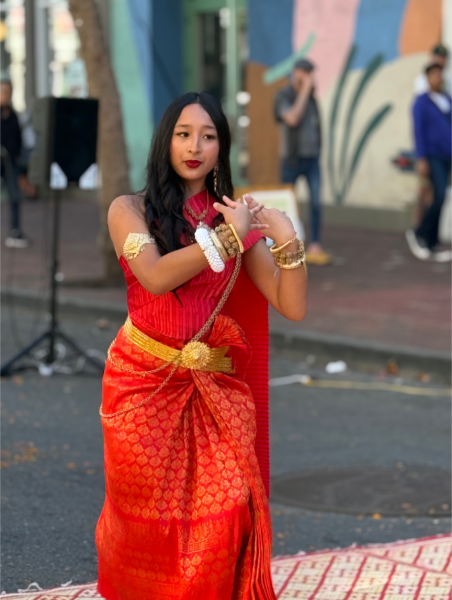
Laughter and chatter can be heard as girls apply makeup and don vivid traditional attire, preparing to take the stage and tell stories of their heritage and culture through dance.
Junior Ava Saephan said she started learning Cambodian classical dance in September 2024, aiming to get in touch with her cultural roots.
“I dance not only to preserve my culture, but because it is the only real connection I have with my grandparents as I don’t speak Khmer,” she said.
(Ava Saephan)
Saephan said every Friday afternoon, she goes to Clinton Park to practice with the Khmer Amathak Dance Troupe.
Director and dance instructor Moragaut Souet-Samounn said a typical practice is around two and a half hours. They spend the first 15 minutes stretching, then split up into different groups to practice dances.
Saephan said her favorite aspect of Cambodian classical dance is performing, which her group does about twice a month. They showcase various dances, each telling its own unique story. She said one of her favorite dances to perform is called Apsara.
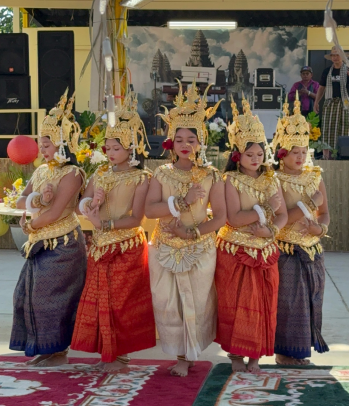
“We’re dressed up in beautiful clothing, a lot of makeup, and crowns, because Apsaras are seen as angels that have come from the heavens to the Earth by God as a present for us, so we’re worshipping these beautiful ladies,” she said.
While Saephan said each dance only lasts around ten minutes, it takes a long time to prepare for each performance.
“It takes hours to get dressed,” Saephan said. “All of our skirts are folded so that it fits our size, so it’s just like a big skirt, or fabric, and it takes about an hour to put on all of our clothes for each person.”
Saephan said the clothing helps portray different characters within the dances.
“Usually our costuming is always really shiny and gold, and we usually have very bold colors that kind of stand out,” Souet-Samounn said. “The girls, they wear makeup and always red lipstick. They have jewelry from head to toe. And then boys, they’ll have either a whole full suit, just suited up kind of like a warrior monkey.”
Saephan said that after getting ready, the group prays together.
“We get in rows and then we pray before we dance, just honoring our ancestors before dancing, because it’s kind of a tradition to get permission to do it,” she said.
Saephan said she hopes to continue doing Cambodian classical dance in the future.
“I don’t speak my natural language, so I thought [Cambodian classical dance] was something my grandparents would be proud of, and something that I could hold on forever,” she said.
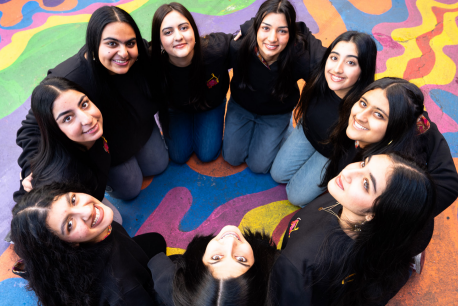
Senior Meher Bachher said she also participates in a form of cultural dance. Baacher has been doing Bhangra, or North Indian traditional dance, since she was six years old, through a program called Vaisakhi Raat, a coalition of 16 dance teams based in San Jose.
“It’s really just given me a sense of community and people who you know are part of my identity,” she said.
Despite the three to four hours of driving Bachher said she does every Saturday to get to Milpitas, she really enjoys the weekly practices.
“Being able to have that space where you can kind of just let go and not really think about anything academic and not think about all of the responsibilities that you have, I think that would be my favorite aspect,” she said.
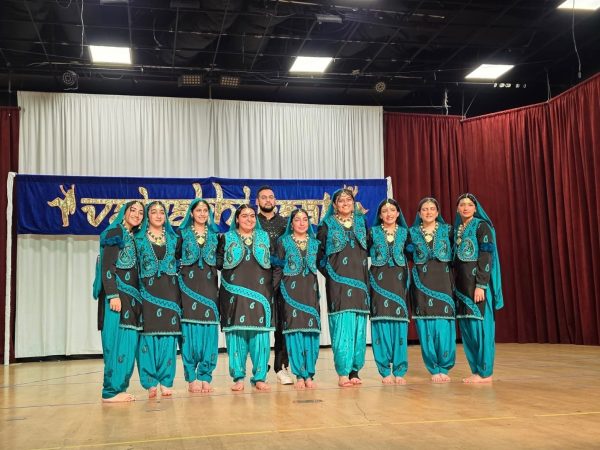
Bachher said that having grown up together, her team is very close knit.
“I’ve been part of the same team for 11 years, and we’re all in similar stages of life, and so being able to have that camaraderie is something that’s really, really central to my experience,” she said.
Bachher said the program hosts an annual New Year’s performance for the Sikh community, taking place in April at the ICC Center in Milpitas. After getting ready together, the performances start in the evening, and last a few hours. Once the performances are over, the community eats and dances together.
Bachher said she loves watching the other teams of different age groups perform.
“Just being able to see what everyone has created and how everyone decides to put together their passion and their pride and their identity, I think it’s so sweet,” she said.
Bachher said Bhangra is very important to her community, and is always present at cultural events.
“The Sikh community, and the Punjabi community at large, has faced a lot of religious persecution, a lot of cultural persecution, but throughout it all, having a form of community has been really, really central,” Bachher said. “And just one of the ways to celebrate that, I think, is this dance.”