




















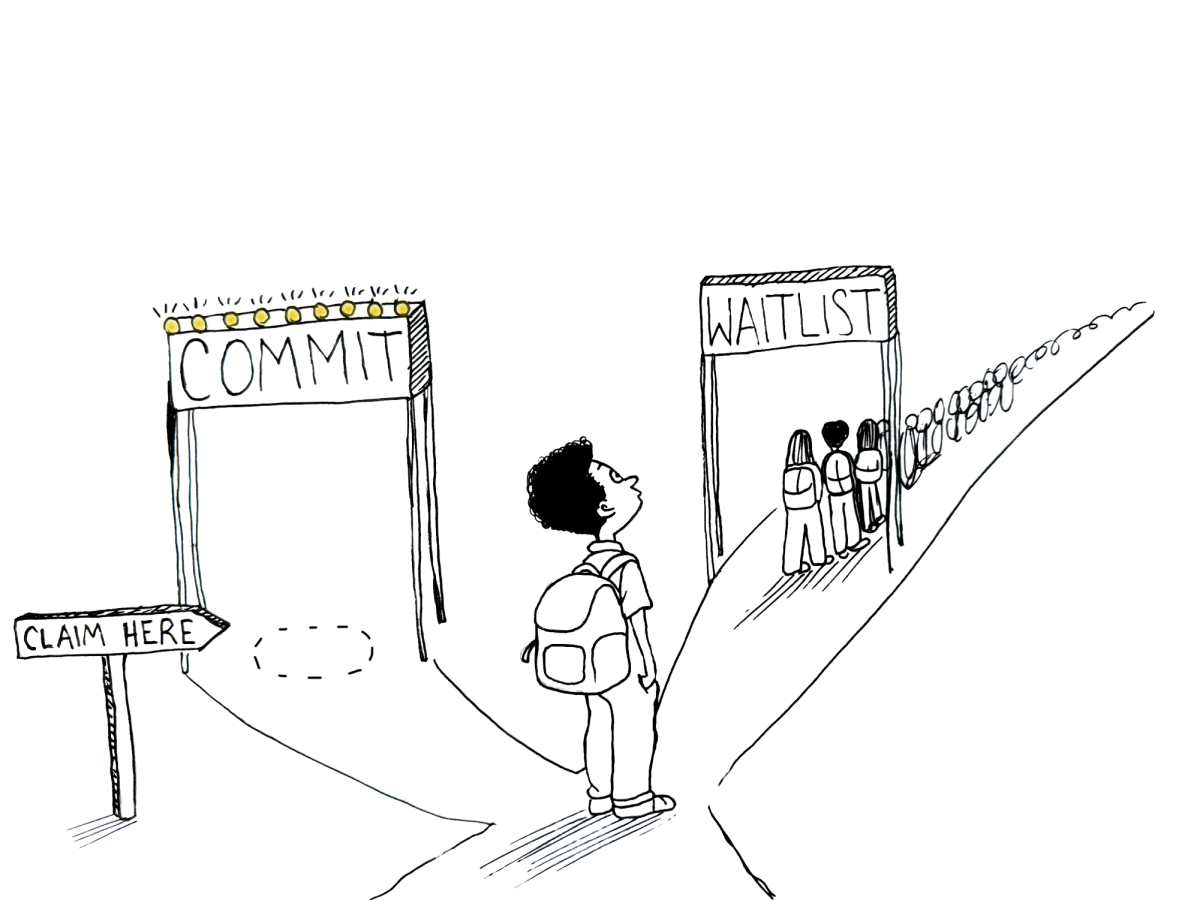
As the student opens the application portal their nerves skyrocket, they click status update and the bolded underlined words ‘view your decision letter’. What you’re hoping to be a screen of overwhelming confetti turns out to be a jumble of letters where one word stands out, Waitlist.
According to Forbes there are steps to take after being waitlisted from a school. Step one is to decide if you are still interested in the school after being waitlisted. Then it is best to accept a spot at your next school of choice, so you ensure you have a place to go in the fall. If you still want to attend the school, it’s best to write a letter restating your desire to attend. Lastly, don’t let your grade suffer since it is especially easy to get senioritis towards the end of the year, and make sure to stay patient and wait for the college to reach out back to you.
“It’s a disappointing feeling [getting waitlisted]. When I looked at some of my applications I was hoping for some more solidified responses so that I would be able to make concrete decisions instead of being in a state of uncertainty,” senior Nate Eidt said.
Eidt said he has been waitlisted at three schools so far. He has been waitlisted at University of Washington, University of Wisconsin-Madison, and California Polytechnic State University, San Luis Obispo.
“It’s really affecting where I am going to visit. I’m for sure going to visit all the colleges that I have been accepted to, but in case I get off the waitlists at other schools I’m also planning on visiting some of those as well,” Eidt said.
Being waitlisted takes away from certain events like admitted students day, where accepted students can experience college life before committing. It helps students decide if a school fits what they want by touring the campus and the dorms, attending lectures, and meeting potential future classmates.
Senior Meher Bachher said she has also been waitlisted at some schools.
“It doesn’t feel great to be waitlisted. It draws out the whole process and makes you feel more uncertain about your future,” Bachher said. “Sometimes I found it to be worse than a rejection for some schools, because it creates more stress and doubt.”
Eidt said that being on the waitlist takes away from the end of senior year experience because there is no definitive answer about where he will spend the next four years of his life. He feels that it postpones the gratification he has been working hard for.
Bachher said she wants more clarity about her future and where she will end up going.
“I would be lying if I said that I didn’t wish that I could have a more definitive answer as to where I’ll be spending the next four years,” Bachher said.
Senior George Bishop said he is planning to commit to Gonzaga University or University of Connecticut, and will only change commitments if he gets off the waitlist at University of Washington.
“I’m not gonna count on the waitlist acceptance coming out, so whatever school I put my deposit into I’ll rep them on Instagram and with the cap and gown,” Bishop said.
Not only is the senior year experience affected, but the way a senior would plan for college is also impacted.
“Being waitlisted affects who my roommates will be for college, where I will visit to see if I like the college; all of that is affected with this huge uncertainty,” Bachher said.
According to BigFuture, the College Board’s online student resource, on average, colleges admit about 20 percent of students who choose to remain on waitlists. This percentage varies per college, with the nation’s most prestigious institutions accepting a range of zero to seven percent of students off the waitlist.
“I will wait for a few waitlist decisions before I commit. Depending on the school, if I committed and then got off the waitlist for one of my schools, I would change my decision,” Bachher said.
Committing to a college means to submit an enrollment deposit by May 1. The deposit can range from $100-$1000, which is typically nonrefundable so switching commitments means losing the deposit.The deposit officially secures a student’s spot for an incoming class, signals an intent to enroll, and allows students to register for orientation and housing.
“Housing is a big deal for college, so being waitlisted may stop students from getting what housing they want,” Bishop said. “Being waitlisted definitely makes it harder to plan for college, because for housing, you want to get on that early, and not knowing where you are gonna go slows down the whole process.”
According to IvyWise KnowledgeBase, Colleges start evaluating their waitlists after May 1, which is National College Decision Day. Many students on the waitlist hear back in May or June. However, they could wait as long as July or August before receiving an update on their status.
“The latest I could hear back from Washington is Aug. 15, which is around when college would start,” Bishop said.
PHS graduate class of 2024 Ruby Guzdar said she initially committed to Colgate University and then when she got off the waitlist at UCSB she changed her commitment.
“I was waiting for the schools I was waitlisted at to get back to me but the deadline was approaching so I decided to commit to Colgate. In the back of my mind I had a plan to either go on a gap year or transfer after freshman year because I didn’t see myself going there,” Guzdar said. “A couple days before the UC deadline, and like a week and a half or so after I committed to Colgate, I got into USCB, and immediately knew I wanted to go there.”
At Piedmont there is an Instagram page dedicated to telling people where every senior has committed to college.
“PHS makes it a big deal where people are going to college. It felt like I was the last one to decide, and it created a lot of stress,” Guzdar said. “The college culture at Piedmont is very competitive, and it’s hard not to buy into it, but very important to at least try not to.”
PHS graduate class of 2025 Ellie Bleharski said she had been waitlisted at six schools, and everyone else around her was also being waitlisted a lot.
“I was waitlisted at Boston College, University of North Carolina, University of Michigan, Vanderbilt, Cornell, and Brown,” Bleharski said. “It didn’t feel too bad to be waitlisted since it was happening to a lot of people, and I had already got into one of my top choices, John Hopkins University, so I didn’t feel stressed at all.”
Bleharski switched commitments from John Hopkins University to Cornell after getting off the waitlist.
“When I visited Hopkins I ended up hating it, so I started to consider other schools,” Bleharski said. “I got off the waitlist for Cornell on the day of graduation, but I wasn’t really considering it all. I then visited the school and I ended up loving it, so I switched commitments in the summer.”
Bleharski said that once she saw the dorms at Hopkins it factored into her decision of switching commitments.
“The housing [at Hopkins] was terrible, even though the housing costs are around the same for both schools, Cornell housing is considerably better for the price,” Bleharski said.
Bleharski said the transition from Hopkins to Cornell was very smooth.
“Since the housing prices were similar, my roommate at Hopkins was going to be random, I wasn’t receiving financial aid from Hopkins, and I got my deposit back, all those factors made it really easy to switch schools,” Bleharski said.
Bachher said the best thing is to remain positive no matter what decisions a college makes.
“All you can do is trust that you will end up where you are meant to be,” Bachher said.