










Bounding around the brightly lit multipurpose room, elementary school students eagerly select books from the tables and display shelves of the Book Fair, pop music from the ongoing dance class blaring in the background. Just down the hallway, the Wildwood library’s doors stand open, welcoming students in to peruse the displays or visit the checkout counter. But by the time these same students are in high school, something has changed: now, the interior is darkened, a posted schedule dictating the periods the library will be open.
Beginning in the fall of 2024, the decision not to replace former librarian Kathryn Levenson due to budget cuts led to a restructuring of the staffing and availability of the PHS library, reducing the number of hours per day that it could be accessed by students.
“Previously, we had a full time teacher-librarian that was always available to help students with research questions or genre-specific book recommendations,” library media technician JacobAn Stahl said.
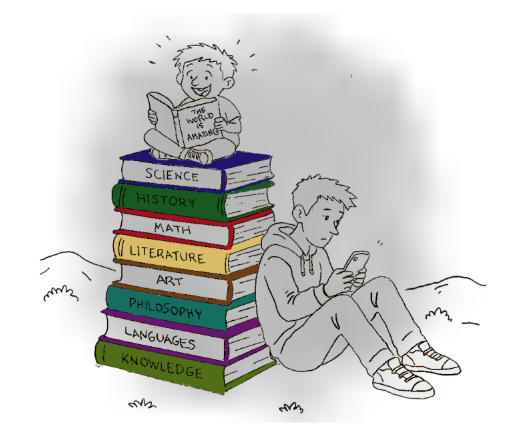
Reading for enjoyment has become far less common than it used to be—in fact, a 2025 study by the University of Florida and University College London found that daily reading for pleasure has dropped by over 40% in the last 20 years—and Piedmont is no exception to this phenomenon, which some students attribute to no longer having consistent access to the library.

Monica Wesolowska
“There’s definitely less emphasis on reading, we don’t go to the library nearly as often. All [it’s] really used for is, it’s a place to study or a place for us to pick up our textbooks,” senior Ella Smithers said. “I think the fact that it’s never open is just drawing people in less, and even if they weren’t originally coming for books, if they were coming to work or for tech, they’re just around books less, so there’s less exposure [since] they’re not seeing all the books up on the wall.”
Junior Ben Ramakrishnan said he considers the limited access to the library as restricting students’ investment in reading for pleasure rather than just for classes.
“Obviously it could be attributed to other social factors of our generation, but honestly, I think just the fact that you can barely access the library is definitely one of the main reasons why people aren’t reading that much for pleasure,” junior Ben Ramakrishnan said.
Although Stahl said that it is difficult to determine quantitatively how use of the library has changed over time, they believe that much of the decline in reading is because of the heightened workload of high school occupying more of students’ time.
“What I can for sure say is that the change in workload from middle school to high school finds even the most avid reader taking in far fewer books a year,” Stahl said.
Many students agreed with this assessment, pinpointing a dropoff as occurring in late middle school or early high school.
“I think I read the most in middle school, or maybe, like, freshman year-ish. It’s definitely gone down as I’ve gone through my time in high school, since [I have] less free time in general, especially because I do robotics and whatnot,” junior Ed Balasingham said.
However, the heightened intensity of coursework and extracurriculars in high school are not the only reason for this phenomenon, which Tiffany Cothran said she observes even among the younger students she works with as an elementary school librarian.
“I noticed that often, for the most part, kids are pretty voracious readers, or at least, check out books a lot, they want more and more books early on. And I start to see dips in that in fourth and fifth grade, and I’ve been trying to figure [that] out,” Cothran said.
Besides her work managing the library collections at Havens and Beach and her teaching load to provide electives for younger students during their teachers’ prep periods, Cothran is also involved in the organization of community events centered on reading, such as Book Fairs or Read-a-Thons. She said that she particularly values these because they generate enthusiasm around reading among students while giving them the opportunity to independently explore new series and genres.
“I love doing Book Fairs because [they’re] outside of school, so it feels special. It’s like having your own little bookstore and kids get excited about that, and anything that excites them around books makes me happy,” Cothran said.

Annalise Gudiksen
Many current students reflected on the Book Fair as being valuable in terms of giving them a designated time to become aware of and purchase new books.
“That was definitely a thing that everyone went to, and I also feel like we would get these Scholastic catalogs and every single person would get books from the catalogs, even if it was Diary of a Wimpy Kid or whatever,” Ramakrishnan said. “Regardless of what the material was that we were reading, we were reading, and that’s better than nothing, which I feel like is what we’re seeing today.”
Along with buying books for themselves, visitors are able to purchase novels for teachers’ classrooms, with each teacher assembling a specific list of requests tailored to the age range and interests of their students. Furthermore, additional events to incentivize reading such as read alouds by the librarians and author visits often run alongside the Fair, the latter of which Havens library assistant Alex Donnelly said has helped to introduce kids to new authors.
“We had Mac Barnett come in last year, so that was very cool,” Donnelly said. “Having that real life touchpoint, it means that kids go, ‘oh, I met the guy who wrote this book, let me check this book out’, so I do think that having personal connections to things is really important.”
Balasingham said that he recalls having the opportunity to meet cartoonist and comics writer Judd Winick at a Book Fair when he was younger, inspiring him to become invested in his eleven-book graphic novel series Hilo.
“One author I remember meeting in particular was the author of Hilo. That was pretty cool,” Balasingham said. “After that, I think I bought every single one of his Hilo books.”
Today, the Book Fair and events like it remain staples of the elementary school experience across all three Piedmont schools. While the inventory offered has shifted this year at elementary schools such as Wildwood due to their supplier Books, Inc. going out of business, Cothran said that they have been experimenting with new vendors, such as a local bookstore in Orinda.
“I love the Book Fair because they just have so many options about what everybody likes to read, and it’s not just one kind of book,” fourth grader Beazy Roman said. “There’s definitely a variety of genres.”
Beyond the pure enjoyment found in events such as these, reading holds demonstrable value in a variety of contexts, one of which is vocabulary acquisition. According to the National Institute of Health, much learning of new words for older children and adults as well as early readers comes from engagement with written texts, since they frequently contain words that individuals might not as readily have exposure to through spoken language.
“Just by reading, you learn more words, because you’ll be reading and you’ll be like, ‘Hmm, I don’t know this word’, and then either you just figure it out from context or you’ll Google it,” Balasingham said.
Bell said much of her investment in reading for pleasure comes from a desire to better understand cultural references and develop an understanding of literature.
“There’s so many books that are so heavily referenced throughout society, in school and outside of school, and reading the original if that’s feasible [and] it’s not some super dense text, I think holds value, because you can form your own opinion, and you’re not just spouting back the opinions of others. You’re not relying on someone else to have read it for you,” Bell said.
According to an article in Scientific American, reading literary fiction has been shown to be correlated with higher levels of empathy and emotional intelligence compared to other genres, such as nonfiction, or not reading at all.
“I love reading. It’s just one of my favorite things to do, because you just get so interacted with your book and you never want to stop,” Roman said. “Right now, I’m reading a book called The Land of Stories: The Wishing Spell, and the two main characters are twins, and I’m a twin, and I really connect with the girl twin named Alex. We kind of have the same character traits, which is really cool.”

Donnelly
Not only is reading valuable for allowing the audience to relate to characters in whom they recognize themselves, but also for promoting an opportunity to explore perspectives that differ from their own, something Cothran said that she works to emphasize through curating displays for heritage and awareness months as well as ensuring multicultural representation when pulling books on topics like holidays or food.
“We, at least at Piedmont, see a big part of our job as putting out stories that reflect a variety of identities, and I really take that as a big part of my job, like, ‘Okay, how can I present [and] teach stories so that everyone feels included and sort of welcomed in our schools?’” Cothran said.
Several interviewees also mentioned the metaphor of “mirrors, windows, and sliding glass doors”, a phrase originally coined by professor Rudine Sims Bishop in 1990 to describe the value of literature in reflecting a person’s own experience (mirrors), giving them insight into that of others (windows), and actively entering into these other worlds to engage with them (sliding glass doors).
“I feel that the way that we understand ourselves and the world is through stories,” author Monica Wesolowska said. “We carry stories about ourselves in our heads without even being aware of it, so I think it’s incredibly important that we get exposed to all kinds of stories so that we don’t get stuck in one story about who we are, especially if that’s a story that’s limiting.”
Besides the general understanding of oneself that can be found through reading, Smithers said she finds reading to be especially valuable in the largely homogeneous community of Piedmont to provide exposure to marginalized identities.
“I say this as a queer person, [people are] missing out on so many experiences that you will never or have never felt,” Smithers said. “[Through reading], not only are you getting to know what the world is like for other people, but you’re also setting yourself up for success.”
Ramakrishann agreed with this assessment, saying that reading has been incredibly formative in developing his sense of self and that he believes it to be a uniquely valuable medium.
“Without having reading as a gateway to explore not only your identity, but other people’s identities, I’d imagine you might feel a little lost with regards to that,” Ramakrishnan said. “I just feel like it’s so important to understand multiple perspectives in a way that’s difficult to get when you’re not reading.”
Sophomore Annalise Gudiksen said she appreciated the novel Fourth Wing by Rebecca Yarros, the protagonist of which has an unnamed connective tissue disorder inspired by the author’s real-world experiences with Ehlers-Danlos Syndrome, for integrating a unique perspective of chronic illness into the character without taking away from her strength and resilience.
“Although it’s a fantasy romance, it really kind of provides a new perspective [and] I think Rebecca Yarros did an amazing job showing [the protagonist’s] condition and how it affects her,” Gudiksen said. “I thought it was so cool to read that book, because obviously some people might consider it a weakness, but she works with it and grows to be a more clever and greater person because of the experiences that she’s gone through.”
While the benefits of reading are evident, the problem remains: on a local and national level, reading has become culturally deemphasized due to conflating factors such as busy schedules, anti-intellectualism, and the popularization of short-form content. However, there are several strategies that can be employed to reintegrate reading into daily life, such as using books to spark casual conversation, as is done with other forms of media.

JacobAn Stahl
“Think about how when a movie comes out that’s really, really good, everyone says, ‘Have you seen, have you seen, have you seen?’ or a TV show, ‘Are you watching?’, right? I think you can do the same thing with books,” Wesolowska said. “If people get excited about a book and say to their friend, ‘I’m really loving this book, you should read it too,’ then you can get together and say ‘What did you think?’ I think that can keep people reading.”
Outside of individual interactions, partaking in reading-related activities such as book clubs can also be valuable to instilling regular reading habits. PHS parent Kimery Leong has been a member of two such groups throughout her life, one with her former coworkers at UCSF and the other made up of fellow Piedmont parents. Having participated in the first for over 25 years, Leong spoke to the value of organized meetings for regularly discussing literature and forming social connections that have extended far beyond their original purpose.
“We all found out we all love to ride bikes, and so we did a 35-mile Women on Wheels bike ride a couple years ago,” Leong said. “And then now, a lot of us are getting to the stage of empty nesting and, you know, one of the ladies brought up, ‘Hey, let’s start playing mahjong.’ It’s been really nice to branch out and not just read books together and meet for a book club.”
When working on one’s reading habits, it’s important to remember that occasional setbacks or “reading slumps” are to be expected regardless of a person’s intake. Despite cultivating a lifelong love of reading throughout her childhood and professional experience as a writer, Wesolowska noticed her own reading habits waning following the rise of personal technology due to the short-term gratification it offered, a trend she also observed in her two sons. To combat this, she said that she made a conscious decision to recommit to her passion and more actively make time for reading.
“I did have a little dip in reading after the iPhone became incredibly powerful, and I found myself reading a lot of short things on my phone, and that eats into one’s reading time in a huge way,” Wesolowska said. “So I did have to actually very consciously ask myself, ‘Don’t you like to read anymore?’ I was a little nervous, but I said, ‘I’ve got to get a novel out and sit down and see what it feels like.’ And I realized, of course, reading is my favorite activity. So, I have to make sure always to create time for that.”
Donnelly said that modeling a personal investment in reading can be valuable for parents struggling with encouraging their children to read.
“I would ask them, ‘does your kid ever see you read anything?’ Because I think the readers that I know, their families read,” Donnelly said. “It’s that whole Steven Sondheim ‘children will listen’ thing. They won’t listen to what you say, they listen to what you do.”