



















Falling asleep on FaceTime, nonstop texting, making endless plans, only to make eye contact in the hallway and look the other way. “We’re just talking.”
According to a TPH survey with 182 student respondents, the talking stage emerged as the most common relationship type at PHS.
Yet this type of relationship, seen as the grey area between friendship and dating, has taken on multiple meanings.
As reported by the survey, students did not agree on a precise place for the “talking stage” on the spectrum from friends (1) to dating (10). However, the most common answer was 7, chosen by 40.7% of respondents, suggesting that most students see it as closer to dating, but not quite there.
Anonymous senior Jane said there are different types of talking stages.
“Some are high-commitment, some are low, and then there are the really poorly communicated ones where no one knows what you are and no one wants to define it,” Jane said.
Despite the complexity, anonymous junior girl Alice said talking stages are thrilling.
“Honestly the talking stage is fun,” Alice said. “Having a crush and someone that liked me, complimenting me, and going to the same school, it was fun seeing him around the halls and then being able to talk to him after school.”
Senior Malia Williams said there is a harmful side to talking stages.
“Talking stages can be fun and exciting but it’s a pretty toxic cycle. A big part of it is the push and the pull, not knowing when they want you and when they don’t. It leads to getting attached and eventually getting hurt,” Williams said.
An anonymous sophomore boy said that this push-and-pull leaves too much uncertainty hanging in the air.
“The worst part is when people either do not talk to one another at all or they talk all the time at home but never at school,” he said.
Junior Connor Fredericks said the gender dynamics rooted in societal norms can play a role in how talking stages begin.
“If it’s a guy and girl relationship, usually it’s the guy texting first or expressing interest. It’s kind of rare, although it does happen, for a girl to go out of their way to initiate talking first,” Fredericks said.
Freshman Aaron Bornstein said that he is unsure if this expectation for guys should be the norm, but said, “It’s just what it is, and it’s always going to be that way.”
With so much grey area comes the looming question of exclusivity. The TPH survey revealed that students are split on this idea of exclusivity. 49.5% said talking stages are exclusive, while 50.5% said they are not.
“There isn’t much of a line. Out of respect for somebody, you probably wouldn’t want to [talk to other people]. I’d rather get attention from one person than get a little bit of attention from a lot of people,” anonymous junior boy Walker said.
Eva, an anonymous sophomore girl, believes exclusivity changes as time goes on.
“I think it’s fine to talk to multiple people in the earlier stages of a talking stage, considering the talking stage hasn’t become exclusive yet,” Eva said.
Exclusivity can also be tied to the idea of purity culture. Typically, purity culture applies to someone’s sexual experience, praising sexual abstinence or being ‘hard to get’. However, purity culture can also refer to one’s experience with talking stages.
“There are a lot of behaviors rooted in purity culture… People think that if you have talked to a lot of people, you’re just talking to everyone, and recently I’ve heard girls say this more about guys,” senior Miranda Liu said.
According to BBC, this theory involves the pressure to be in a relationship. It is common for people to constantly want romantic love and to prioritize that kind of love over other kinds.
“It feels like you’re shooting every shot you can to a point where if it lands in any basket you’re happy,” Jane said.
The non-committal nature of a talking stage has unique implications in a community as small as PHS.
English teacher Hayley Adams said that with a school of 723 students, kids often circumvent the talking stage of a relationship. She said that students are working with such a small pool of people that really no one is off limits.
“At Piedmont, you kind of pass along your friends’ exes. I feel like, ‘Ew, I’m recycling all of them,’” Jane said.
As shown in the TPH survey, 67% of students believe the talking stage typically lasts 1-3 months.
Sophomore Ethan Hammond said there shouldn’t be any minimum or maximum time a talking stage should last. He said in his experience, a talking stage is a lot shorter if he’s really interested in the person, because then he’s willing to go out of his way to make something happen.
“It mostly depends on each person’s accountability, and there shouldn’t be a specific time that something should last,” sophomore Jax Thayer said. “It depends on one another’s comfortability to adapt to one another.”
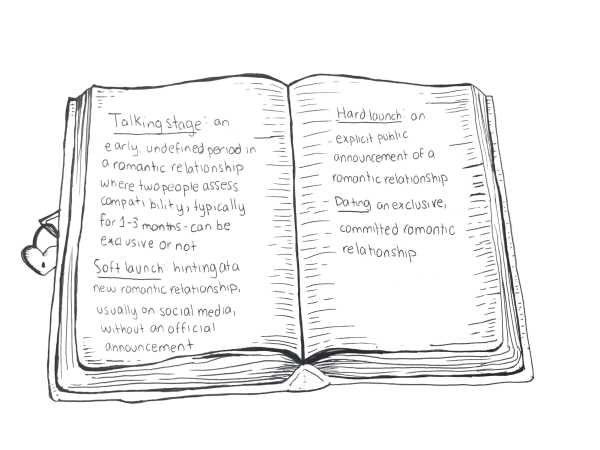
While getting out of talking stages can mean moving forward, sometimes it means calling it quits.
“It could go on for too long and not really amount to anything. A different person could come into your life that fits you better, or maybe you just aren’t attracted to that person in the same way and you don’t want to be anything more,” Fredericks said.
Talking stages end differently depending on the situation. However, senior Malia Williams said there are two main ways it goes down.
“When a talking stage ends, it either fizzles out and there’s no communication on the ending, or it’s a forceful ending where there’s drama because one person has gotten more attached than the other,” Williams said.
Fredericks said it can be awkward after talking-stages end, especially when there hasn’t been a direct conversation about what comes next. He said that if the two weren’t comfortable before or during the talking stage, they’re unlikely to feel comfortable after it ends.
According to Pew Research Center, most teens now build and maintain romantic connections through digital communication such as social media and text messaging.
“[High school talking culture] has changed a lot because of social media and being able to contact one another online,” anonymous sophomore boy Steve said. “It has made us more nervous to go talk to each other in person.”
Hammond said the app Snapchat in particular has dramatically changed the way talking stages come about.
“It’s a lot easier to start talking on Snapchat, so there’s a lot more talking stages that happen, or maybe not even talking, but prospects,” Hammond said.
A key feature of Snapchat is that users can look at a person’s activity levels if their location is turned on. With this, response times have been useful when navigating talking stages.
“I use Snap location all the time, and it’ll be like, ‘This person’s been online for the past two hours, but I’ve been on delivered for eight.’ I just kind of take the hint,” Walker said.
Regardless of how the talking stage is initiated or manifests, Williams said that there needs to be a societal shift.
“I think our generation needs to get it together. We’ve normalized talking stages and hookups and I feel like that removes how special having a true connection with someone truly is,” Williams said. “I feel like this culture has the potential to ruin how other generations will see love.”