















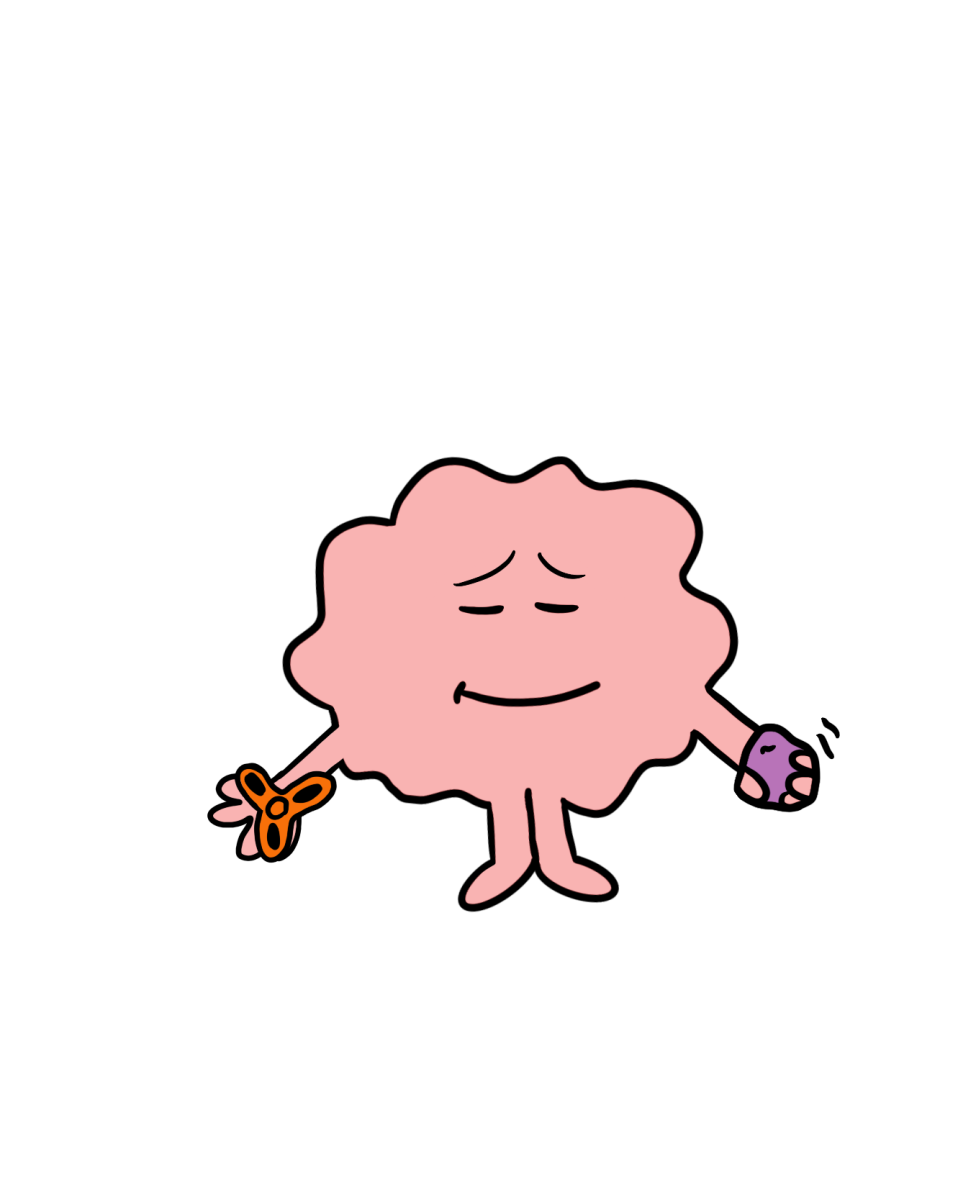
Clicking, whirring, and buzzing fills the room as the students settle down to learn, and fidget with their spinner, once again.
Throughout classrooms, fidgets are seen on desks, in hands, and being passed around. Whether that is a fidget spinner, cube, or NeeDoh, opinions differ on how helpful these stimulants really are.
“I’ve noticed Rubix Cubes being used, and often people will grab various things from around my classroom like little plush anatomical parts,” Health teacher Lael McAuliffe said.
According to an article by Brown Health University, fidgets can provide an easy and accessible way to help self-regulate or concentrate by providing auditory, visual, and tactile input.
“Rubix cubes are a very cerebral fidget. I’ve also seen many different types of NeeDohs,” junior Maximo Miller said.
According to Schylling, the brand that makes Needoh, the term NeeDoh refers to a popular brand of sensory squishy stress toys or fidgets that are filled with gel-like dough.
“When I first noticed them they were everywhere, now I see them less but they are still more popular than other fidgets,” junior Thomas Moison said.
McAuliffe voiced her concern over the stigma surrounding bringing a fidget to school and how fellow peers can interpret it as juvenile to do so.
According to cognitivereasearch.com, the global fidget toys market size was USD 8124.6 million in 2024. It will expand at a compound annual growth rate (CAGR) of 7.00% from 2024 to 2031.
The NeeDoh started to take over as a trend during Dec. 2024.
Miller said that he finds NeedDohs more distracting than Rubix Cubes because their popularity becomes the center of his and his classmates’ discussion. He said that his friends and him would start to pass it around and argue over who would get it next.
“I definitely notice that NeeDohs are super popular in my classrooms,” Miller said.
Moison said that in elementary school he used fidget spinners and they were popular amongst his peers. He said that he used fidget cubes as well. He found that fidget spinners did not help him at all but fidget cubes helped him more.
“For a lot of my students, it is really helpful for them to use a fidget as a stimulant because it fills the part of their brain that would otherwise be thinking distracting thoughts,” McAuliffe said.
Research from 2013 proposes that purposeful fidgeting can increase neurotransmitters that control attention span, helping improve focus. Fidgeting can also make sitting or staying still for long periods more tolerable.
History teacher David Keller said that while fidgets were initially helpful for students who needed them, they would progressively become a bigger issue, as they became the main topic of conversation in the classroom.
“For the people that have them for a specific reason, it helps them, but for the people around them, it distracts them,” Keller said.
McAuliffe said she believes that It’s not that there is anything wrong with the students who fidget more, it is that the students brain has extra capacity, being able to pay attention to many things at once.
“In those situations, it is helpful to have a fidget to occupy part of the brain that needs to be occupied so the other part of their brain is able to do something at the same time and can be engaged,”McAuliffe said.
Junior Amelia Oldrin said that she believes using a fidget is a way to use tactile input to cope with anxious or otherwise distracting thoughts.
“I think that if you are using a squishy, it can help you concentrate by keeping your hands busy. Fidgeting with your hands is similar to how writing down things while reading helps you to memorize them even if you aren’t looking at what you are writing,” Oldrin said. “I feel like after middle school, they weren’t that helpful and I didn’t really use them anymore but I definitely noticed that they became more of a distraction as I got older,” Moision said.
According to CHADD (Children and Adults with Attention Deficit Disorder), fidgeting can sometimes lead to disruptions in concentration, particularly when it becomes excessive.
Mcauliffe said that as kids get older, their goal should develop into self-awareness and responsibility rather than blind rule following.
“I think that when there is a fidget, or a compulsion to go to their Chromebook, helping students to move in a direction where it can come around to a self awareness of, ‘yes, it’s a fidget for now, this is what helps me focus when in the classroom’, but then over time finding other ways in a work setting to more towards the future,” McAuliffe said.